FDE Build Project · Media · Content

From interview recording to article draft,
leaving the words untouched

ScribeClaw is an article-automation agent for "Jjom-Aneun Gijadeul", the Chosun Ilbo startup-interview column. Upload the interview recording and it produces a draft in the reporter's voice — but the point isn't speed. It's guaranteeing, through system design, the trust that "the interviewee's words are never changed."

🏢 Chosun Ilbo · "Jjom-Aneun Gijadeul" 👥 Deputy Editor Seong Ho-cheol (interview column) 🧪 Dev PoC in real use (1 user)
Words as spokenEvery quote checked against the source (VERBATIM)
Asks backAmbiguous figures/dates never auto-corrected
Recording → draftOne upload takes it to an article draft
7-layer contractQuote accuracy guaranteed by design (L1–L7)
The Challenge

In journalism, being right beats being fast

Ordinary transcription and summary tools polish statements to sound "plausible," changing what was actually said. In an article, that's fatal.

1

Automation tools change what was said

Ordinary tools smooth quotes into distortions of the actual statement and fill ambiguous parts with arbitrary guesses. For journalism, which must never distort the interviewee's words, they were unusable.

2

A manual bottleneck

For a 60-minute interview: 1–2 hours to transcribe, 1–3 hours to draft. On top of that, checking each quote against the source was done manually by a person.

3

Transcription shakes proper nouns and numbers

Mishear a company name, product name, investment amount, or date and it becomes an article error. Numbers especially — "a wrong number is still a plausible number" — so text alone can't tell right from wrong.

The Solution

Don't guess — verify, and ask back

Upload recording → company dictionary → transcription → selective correction → angle selection → article draft. It keeps running on the server even if you close the window, and hands off to the reporter whenever judgment is needed.

STEP 1

Company dictionary

Pre-register proper nouns from press releases and IR.

STEP 2

Transcription

Transcribe the recording by speaker.

STEP 3

Selective correction

The reporter reviews only the ambiguous cases.

STEP 4

Angle selection

Set the article's angle and structure.

STEP 5

Draft + verify

A draft with quotes checked against the source.

Feature ① · Preparation

A company dictionary raises transcription accuracy up front

Feed in the company's press releases and IR (links, PDFs, text) before the interview, and it gathers proper nouns and easily-misheard phrases in advance to use as the basis for transcription and correction.

  • Register proper nouns like company names, product names, and investment amounts up front
  • Secure likely misrecognition candidates in advance to reduce errors
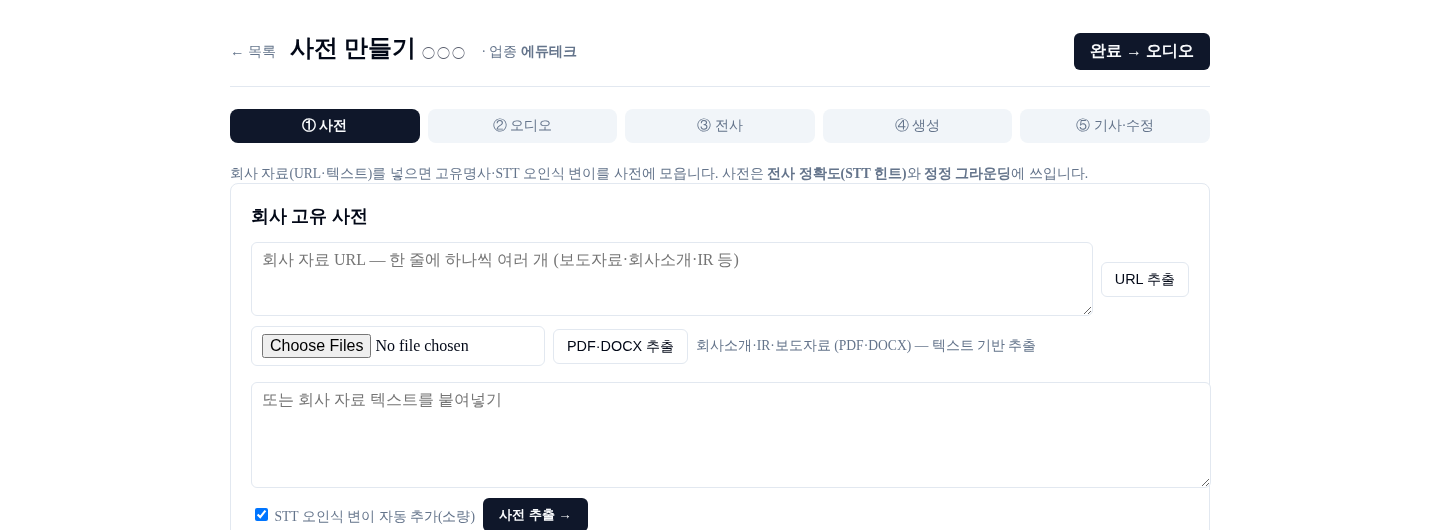
Company dictionary builder — collecting proper nouns from press releases and IR (company name masked)
Building the company dictionary (the interviewee's company name is masked)
Feature ② · Ask back

When unsure, it doesn't guess — it asks the reporter

It auto-corrects obvious transcription errors, but for anything ambiguous — and numbers and dates it never auto-corrects — it asks the reporter to confirm. It shows the original audio for that segment along with the surrounding context, so the reporter only has to choose accept, keep original, or hold.

  • No auto-correction of numbers/dates — a wrong error can't slip in silently
  • Audio playback + surrounding context for a quick judgment
  • The reporter is the decision-maker during writing, not a post-hoc checker
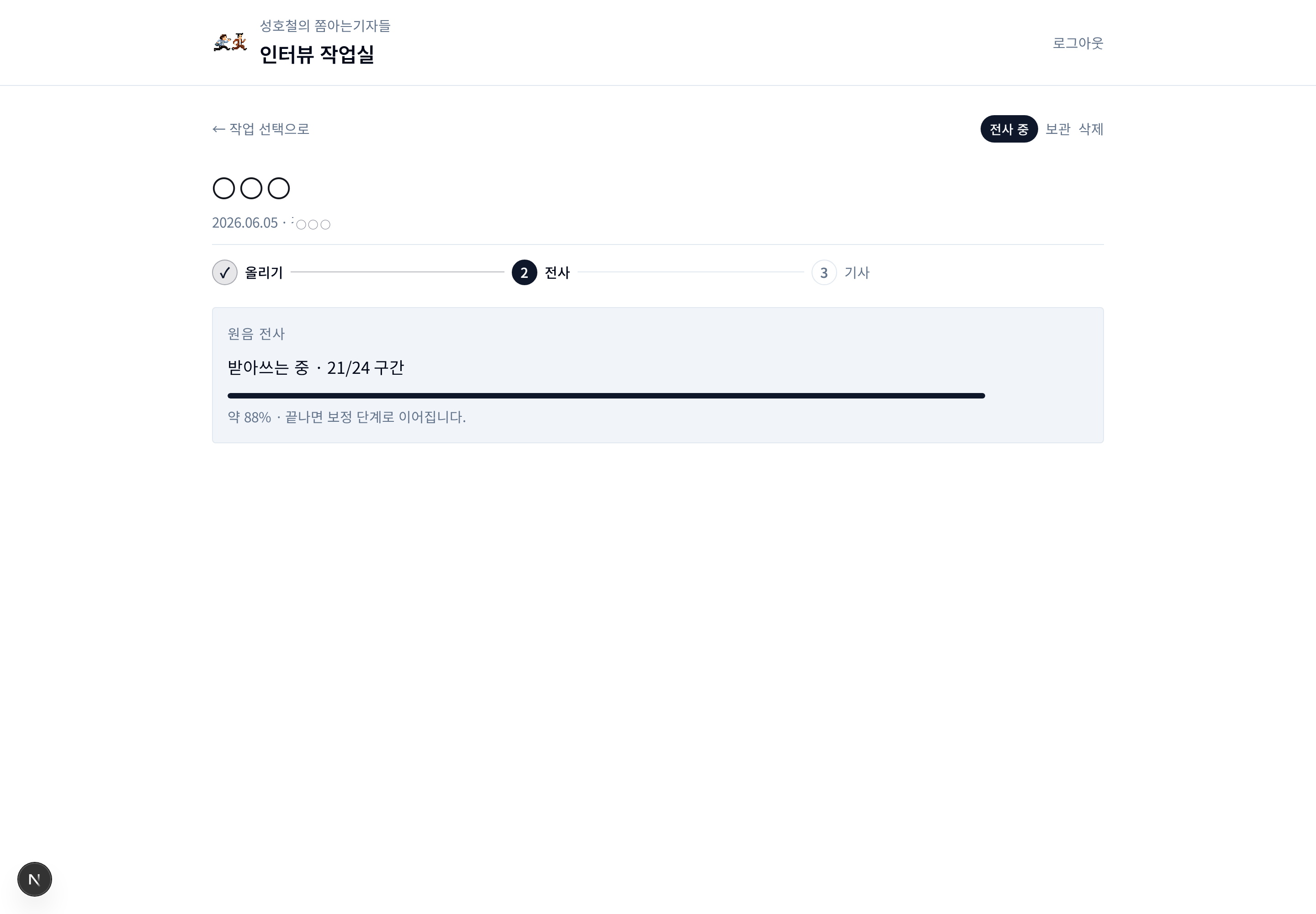
Transcription progress screen — speaker-by-speaker transcription (company and reporter names masked)
Transcription in progress (company and reporter names masked)
Feature ③ · Key differentiator

It checks its own quotes against the source and rewrites what's wrong

It checks every quote in the draft against the source one by one, rewrites only the paragraphs that don't match, and re-verifies — repeating the loop on its own. It also detects and flags unsupported statements (fabricated facts).

  • Check every quote against the source → rewrite only the mismatches → verify again
  • Detect and flag statements without a source
  • Every edit records who, what, and why — traceable and reversible
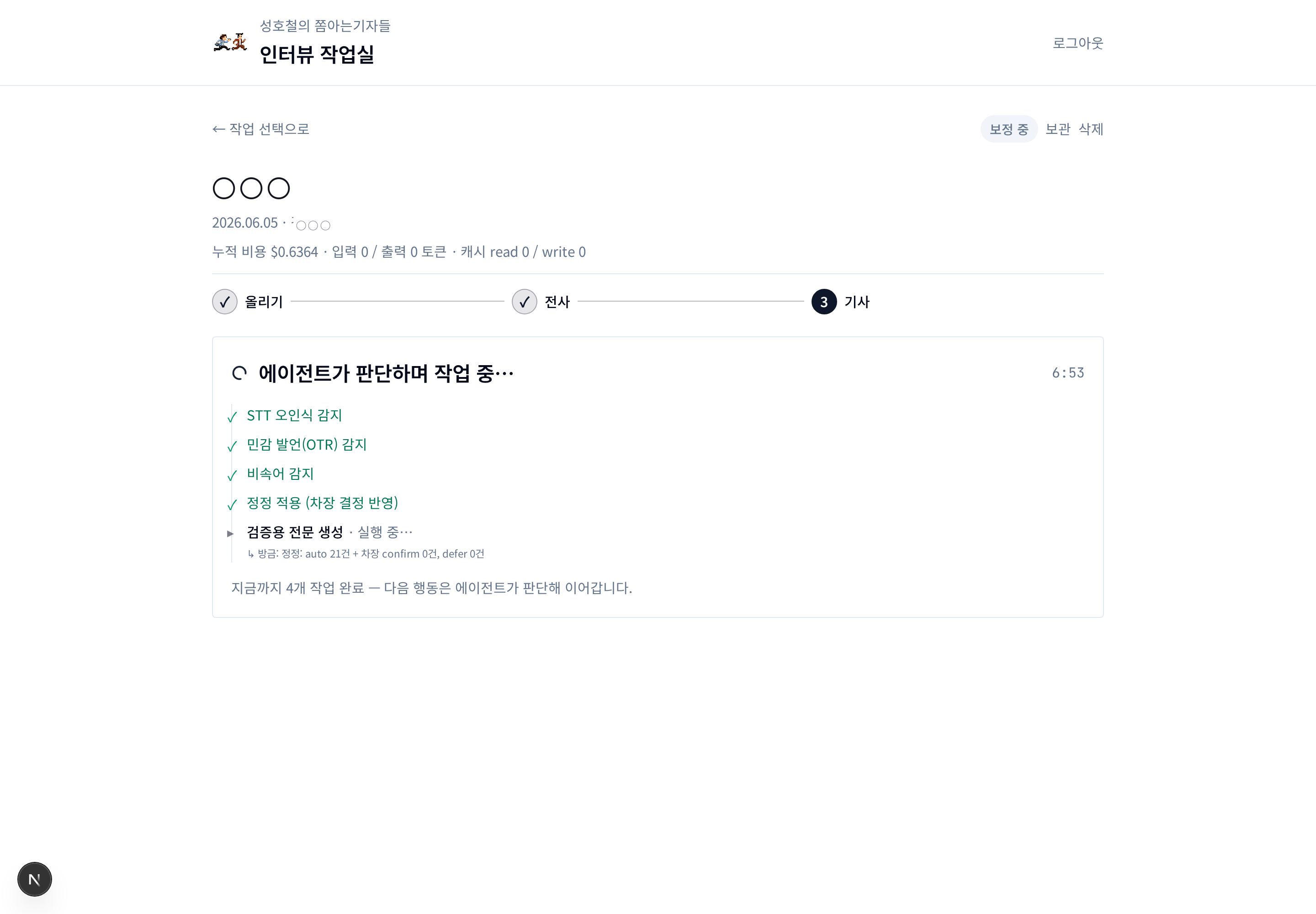
Agent autonomous verification — detecting misrecognitions and sensitive statements → correcting → generating the full text for verification (company name masked)
The agent judges for itself: detect → correct → verify
Feature ④ · Management

Progress and cost per interview, at a glance

Check each interview's progress and generation cost on a dashboard, and pick up work again anytime. It sets the angle first and reconstructs the material as an "article" rather than in interview time order.

  • Transparently shows per-interview status and per-item cost
  • Drafts in the tone and terminology of the reporter's past articles
  • Resume after interruption — the writing context is preserved on the server
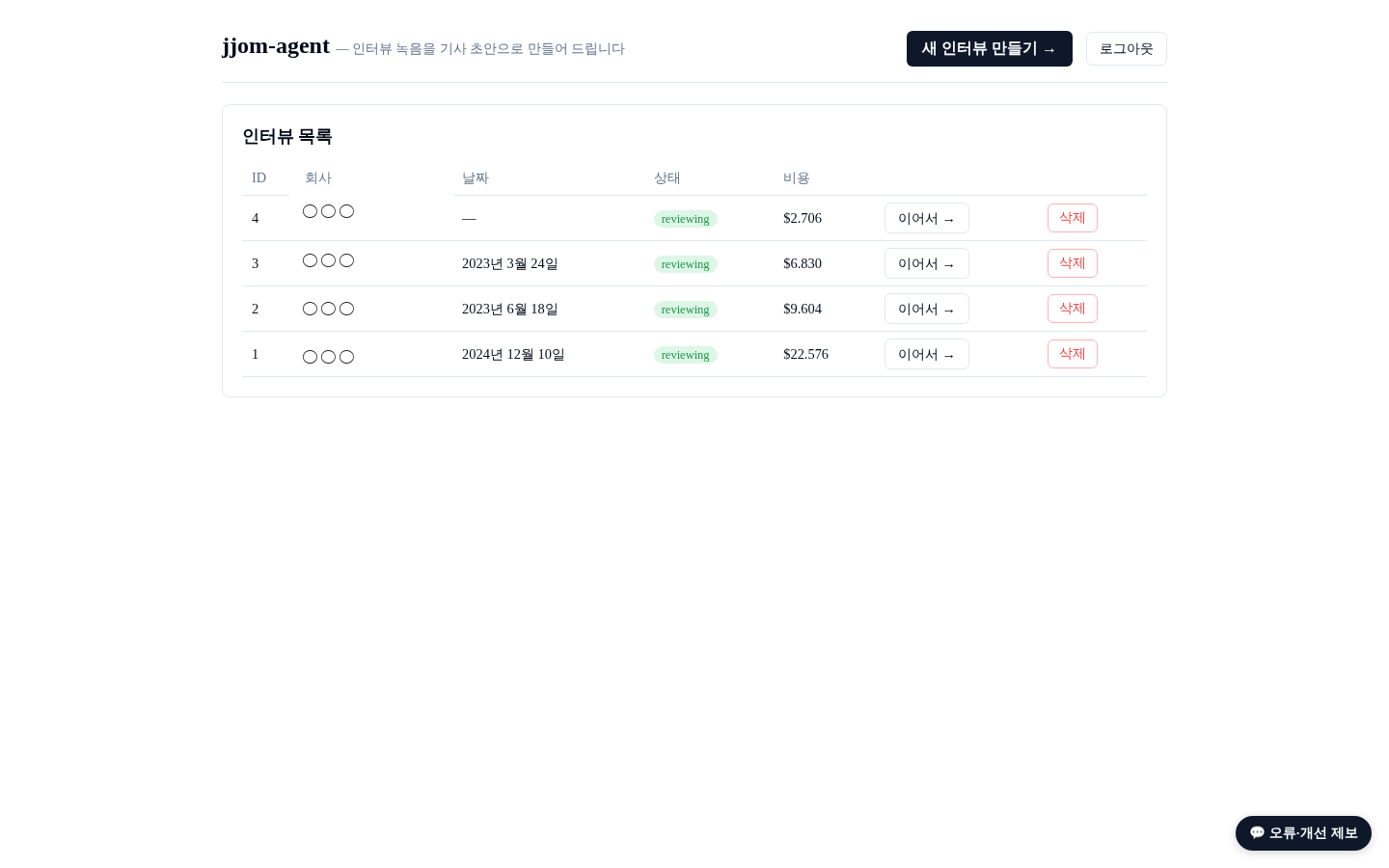
Interview dashboard — per-item status and generation cost (company names masked)
Interview dashboard · per-item cost (company names masked)
"Quote accuracy is guaranteed by system design, not by a person's attention."

Rules like no auto-correction of numbers and source-verification of quotes are nailed down as code contracts (L1–L7), so distortion can't get in to begin with.

The Impact

Automating trust, not speed

This is a single-user PoC stage, so operational metrics (articles published, satisfaction) aren't in yet. Here is what's been confirmed so far.

BEFORE
  • 1–2 hours to transcribe + 1–3 hours to draft
  • Every quote checked against the source by hand
  • Risk of transcription altering proper nouns and numbers
AFTER
  • Upload recording → a reporter-voice draft generated automatically
  • Every quote auto-checked against the source and rewritten
  • Numbers/dates never auto-corrected; if unsure, it asks the reporter
Trust by design
7-layer contract

Journalism principles like source-verification of quotes and no auto-correction of numbers are enforced as code contracts (L1–L7), making it structurally impossible for distortion to enter.

Status

A Chosun Ilbo deputy editor is using it on dev

The gate-loop, reporter confirmation (HITL), and persistent work context all work, and it has processed several real interviews end to end to produce drafts (about $2.7–$22.6 per item). We're preparing stronger fact cross-verification and formal operation.

Tech Stack

On a proven stack

The core: a human-in-the-loop (HITL) runtime that doesn't lose context when the reporter steps away, and a verification loop that checks quotes against the source.

Django · DRF LangGraph (HITL · checkpointer) OpenAI GPT (article generation) Claude Sonnet (outline · notes) Gemini 2.5 Flash (transcription · diarization) standarda-core LangSmith tracing Vanilla HTML/CSS/JS